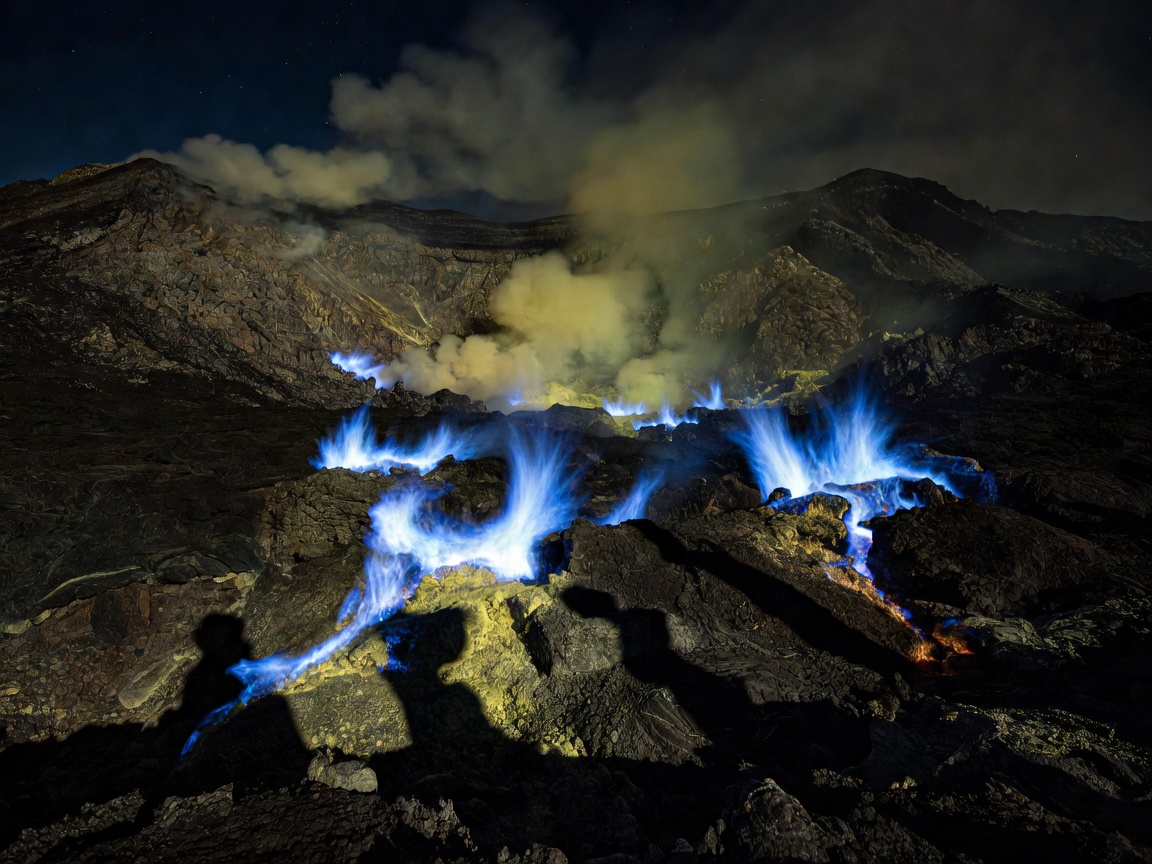
1. Gas Pressure and Thermal Ignition
Contrary to popular urban legend, the lava inside Kawah Ijen crater is not blue. The glow originates entirely from the high-pressure discharge of high-purity sulfuric gases escaping volcanic vents at temperatures reaching up to 600°C (1,112°F).
When these pressurized gases leak through narrow fissures into oxygen-rich ambient air, they ignite spontaneously into luminous blue flames. Part of the sulfur gas condenses into liquid form, producing a glowing liquid sulfur stream that trickles down the slopes in the dark.
2. The Acidic Crater Lake Paradox
Directly adjacent to the sulfur vents rests the world’s largest highly acidic crater lake. Filled with approximately 36 million cubic meters of turquoise water, the lake exhibits a pH below 0.5 due to massive dissolved concentrations of sulfuric and hydrochloric acid continuously fed by subaquatic fumaroles.
3. Environmental Conditions for Miners
Despite extreme sulfur dioxide vapor density requiring industrial gas masks, manual miners extract pure sulfur blocks directly from fumarole condensation pipes at the crater floor, carrying loads up to 90kg up the steep canyon rim.
Official Geological Survey Link: Indonesian Center for Volcanology and Geological Hazard Mitigation