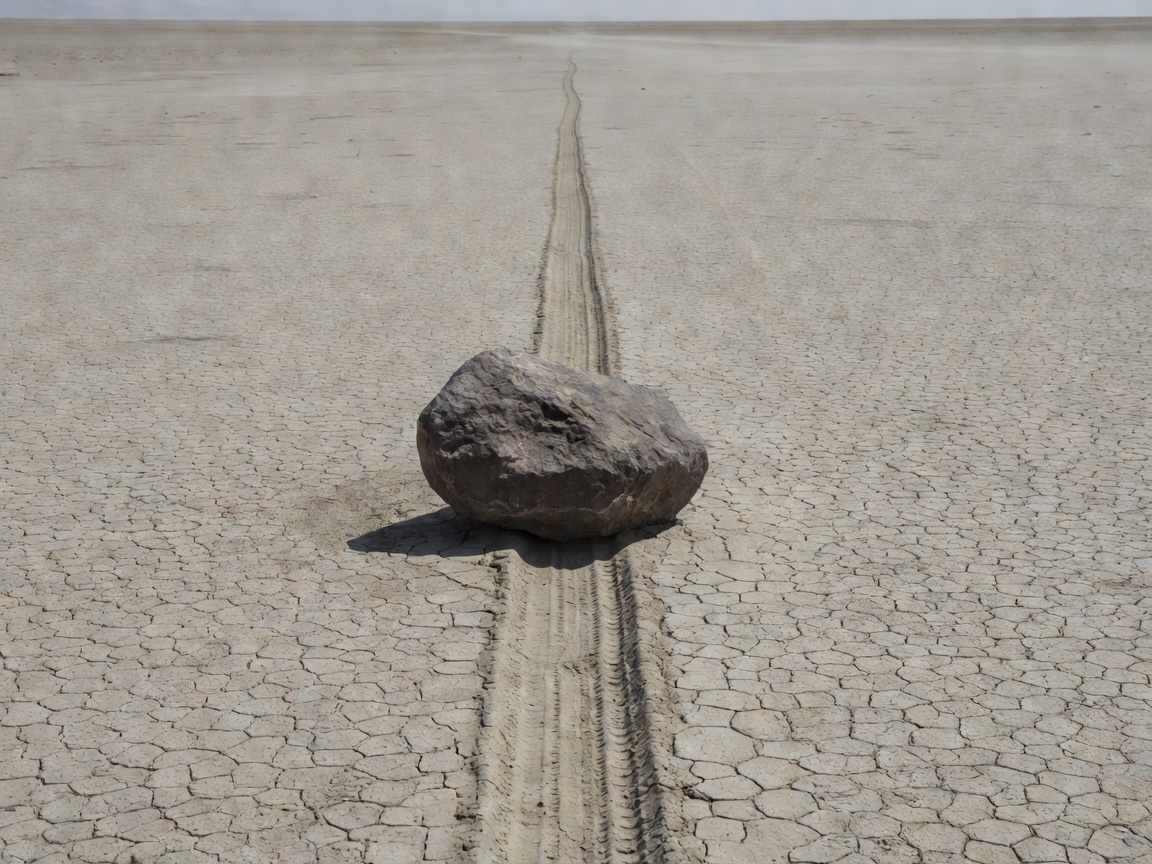
1. The Decades-Long Mystery
Racetrack Playa is a dry lake basin surrounded by mountains in Death Valley National Park. Visitors noticed distinct parallel and curving tracks carved into the mud floor, terminating at heavy boulders. Theories ranged from gravity anomalies to hurricane-force wind tunnels and electromagnetic shifts.
2. Time-Lapse GPS Breakthrough
In 2014, researcher Richard Norris and team equipped custom GPS-trackers inside replica rocks and set up automated weather stations around the playa. What they observed unlocked the rare sequence of physical events required for motion:
3. Kinetic Scale and Friction Collapse
Because the ice sheet provides a massive surface area for wind drag, even light gusts exert enough force to push multi-hundred-pound rocks across the wet, slippery mud bed. The movement speed is surprisingly slow—between 2 to 5 meters per minute—making it almost imperceptible to human observers standing far away.
Official Reference Publication: PLOS ONE Research Paper: Sliding Rocks of Racetrack Playa